Plan on two hours of study outside class for every credit hour, every week. The number comes from the US federal definition of a credit hour. It is one hour of instruction plus at least two hours of outside work a week, for about 15 weeks. For 15 credits, that is about 30 hours of study on top of 15 in class, or 45 hours a week in all. Students report far less: in national survey data, fewer than half of first-year students spend more than 15 hours a week preparing for class. Treat two hours per credit as the budget you plan with. Then adjust it by week three, once your first graded work shows whether you need more or less.
Where does the two hours per credit rule come from?
From federal regulation. The US Department of Education defines a credit hour at 34 CFR 600.2. It asks for one hour of instruction and "a minimum of two hours of out-of-class student work each week". Those hours run for about fifteen weeks for a semester hour, or ten to twelve weeks for a quarter hour.
Three details in that wording change how you plan:
- It is a minimum. "Not less than" and "a minimum of" make two hours the floor a course is designed around, not a cap.
- It assumes about 15 weeks. A term of a different length must hold "the equivalent amount of work", so shorter terms mean more hours each week.
- Your school applies it. The institution defines its credit hour, approved by its accreditor or state agency, and may account for delivery method, discipline and degree level. A syllabus can ask for more.
Where the two hour figure started is less clear. The author of a 2017 Faculty Focus essay questioning the rule suspects it began around 1909, when the Carnegie Unit was accepted as the standard measure of class time, and says she could not find where it came from.
How many study hours is that for my course load?
Multiply your credits by two for study time, and by three for the whole week of course work. For a standard semester:
- 12 credits: about 24 hours of study, 36 hours a week with class.
- 15 credits: about 30 hours of study, 45 hours a week with class.
- 18 credits: about 36 hours of study, 54 hours a week with class.
At 15 credits, the rule adds up to more than a 40 hour work week. That is the workload a credit hour stands for, so plan with it before deciding it is too high.
Accelerated and summer terms
The total work stays and the weeks shrink. A 3 credit course is about 135 hours of work over a 15 week term, or 9 hours a week. Fitted into 8 weeks, it is about 17 hours a week. Into 5 weeks, about 27. Two 5 week courses at once add up to more weekly hours than a 15 credit semester.
How much do college students really study?
Less than the rule. The National Survey of Student Engagement (NSSE), run from Indiana University, asks students how many hours a week they spend preparing for class. That covers studying, reading, writing, homework and lab work.
- First-year students. The share reporting more than 15 hours a week rose from 34 percent in 2004 to as high as 45 percent in 2017. Even at that high point, most first-year students reported 15 hours or fewer.
- Seniors by major. Among full-time seniors in 2014, average preparation ranged from about 12 hours a week for communications, media and public relations majors to about 19 for engineering majors. NSSE estimated these from the midpoints of answer ranges, so read them as approximate.
Now set those beside the rule. A 15 credit load asks for 30 hours outside class. The major group that reported the most preparation averaged about 19.
That gap means two things. Falling short of 30 hours does not make you unusual. And the rule is still the right number to plan with, because it is the workload your credits are meant to stand for. Plan to the budget, then let your results, not the survey, tell you how much of it you need.
Should every course get the same number of hours?
No. Two hours per credit describes the whole load. Inside it, move hours to where the work is.
- Weight by what is graded. A course graded on weekly problem sets needs steady hours every week. A course graded on two papers needs a few hours most weeks and many in the weeks before each paper is due.
- Weight by difficulty for you. Your first graded assignment in each course is the best signal. If a problem set you expected to take two hours took four, that course needs more of the budget.
- Labs and studios count differently. The definition allows the same amount of work to take other forms, including laboratory and studio work. A lab credit may be earned mostly in scheduled lab hours, with less work outside them.
If a syllabus states expected weekly hours, that number beats the rule for that course. The first week is when to look for it, as part of how to plan your semester in the first week.
How do I fit the hours into a real week?
Start from free time, not from the target. Count the hours left after class, work, sleep, meals and travel. Plan about 60 percent of them, and leave the rest for the week to go wrong. The full method, including scheduling backwards from each due date, is in how to turn Canvas assignments into a weekly study schedule.
Then compare. If 60 percent of your free hours is less than twice your credits, the week is telling you something before the semester does. Either the load is heavy for this term's schedule, or some hours have to come from somewhere else.
Setting the hours in Scholarwire
These settings carry the number from this article into the planner:
- Weekly availability. In Settings, under Study plan, set a start and end time for each day you can study. The planner only fills these windows.
- Hours a week. The planner's setup opens the first time you use the planner with work to plan, and later from the Study hours link. On the first step, How do you want to work?, keep The block method and choose Next. The second step asks "How much time can you give?" Choose 5 h, 8 h, 12 h or 15 h, or type a number into Other. For 30 hours, type 30.
- Most per day. On the same step, in minutes. It starts at 240, and no day is booked past it. Seven days at 4 hours is 28 hours, so a 30 hour week needs a higher daily limit.
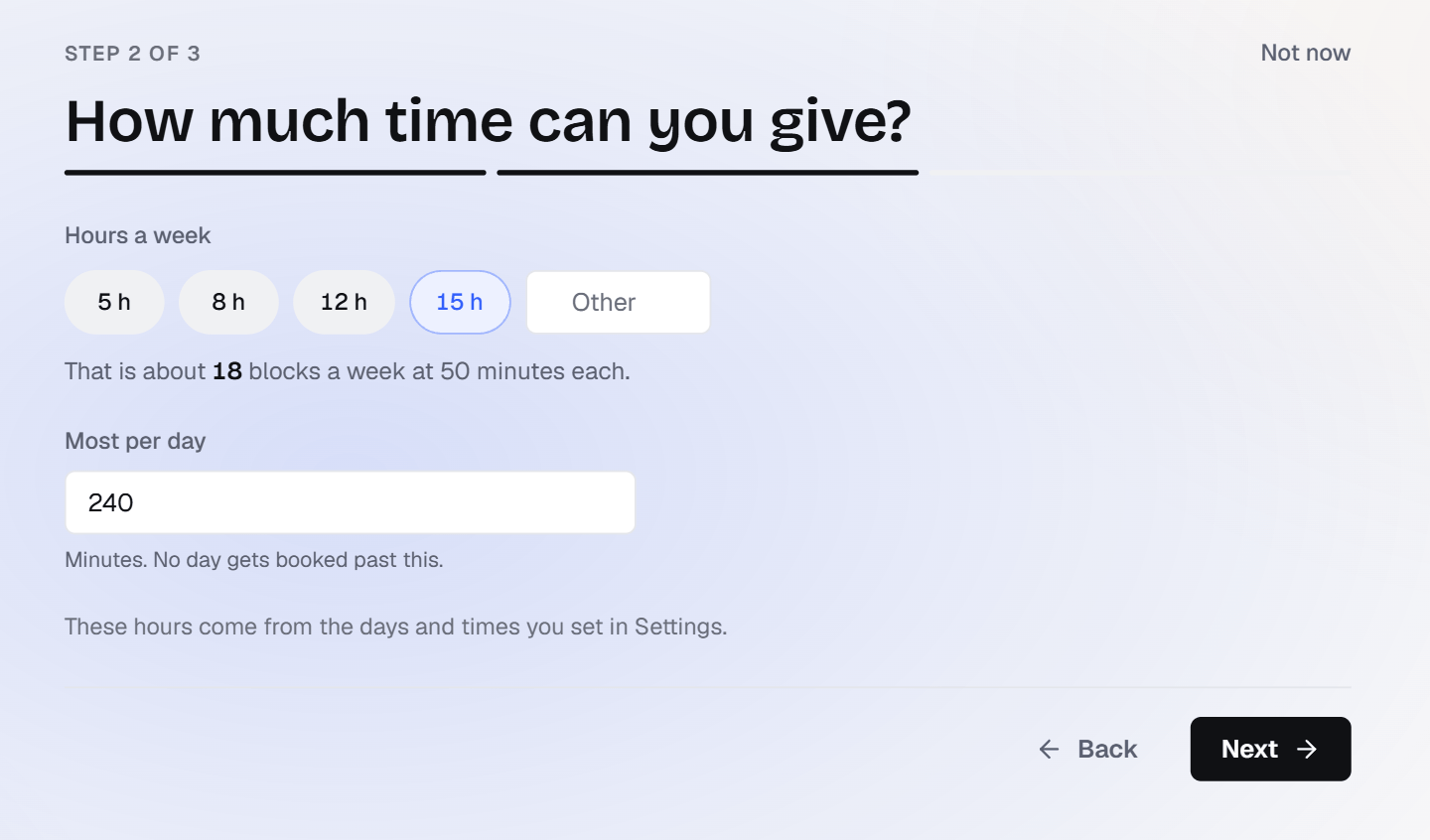
Then choose Next and Build my plan. The planner books study blocks in your free hours, working backwards from each deadline. It never plans over a class, an exam or a block you locked, and it stops an hour before anything is due.
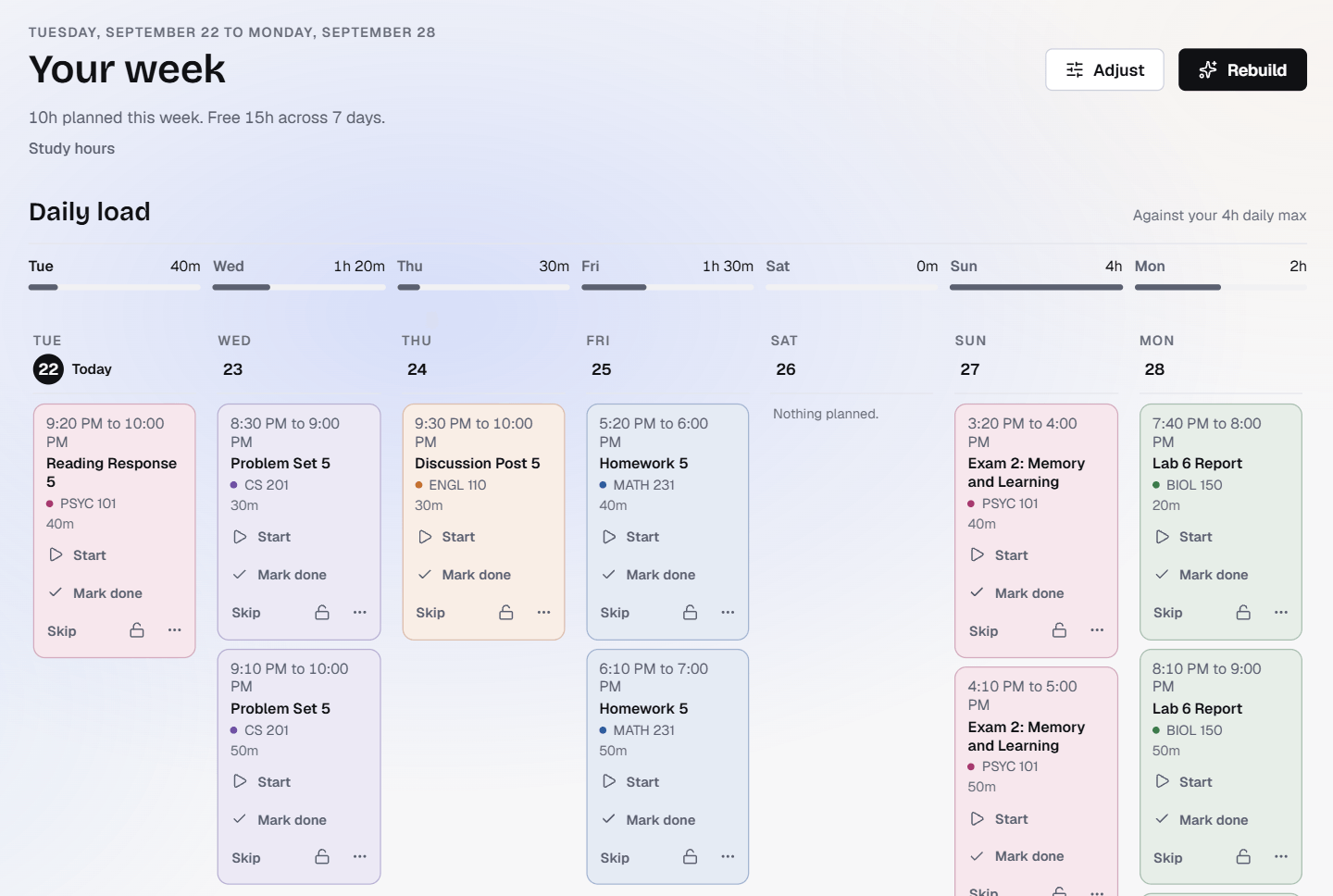
Hours a week is a ceiling, not a quota. The planner books time for the work it knows about, from the estimate on each assignment. In the week above, the planner booked 10 hours of study blocks under a 15 hour limit and left the rest free.
Each assignment in the Your work list shows its estimate as a pill. Click it to choose 30m, 1h, 2h or 4h, or type the minutes. Saving fits that one assignment again and leaves the rest of the week where it is.
What if I work while taking a full load?
Do the arithmetic before the semester does it for you. A week has 168 hours. Take 15 credits at the rule's rate (45 hours), a 20 hour job, and 8 hours of sleep a night (56 hours). That leaves 47 hours for meals, travel, errands and everything else. At 30 hours of work, 37 remain, and a bad week has nowhere to go.
When the numbers are that tight:
- Keep sleep off the table. If the numbers only work by sleeping less, the load is the problem, not the sleep.
- Put shifts on the calendar. In Scholarwire, open Calendar and choose New. Under "What is it?" pick Class or event, give it a title and a date, leave All day off, and set Starts and Ends. Set "Repeats weekly until" to the last week of term, then choose Add it. The planner treats that time as busy and books around it.
- Lighten a term on purpose. Twelve credits instead of fifteen frees about nine hours a week at the rule's rate. Talk to your adviser first, and to the financial aid office if you receive aid, because a lighter load can change your aid.
How do I know if I am studying enough?
By results, not hours logged. Two hours per credit is a planning number. The real question is whether you can do what each course grades.
From week three, look for these signals:
- Your first graded work. A quiz, problem set or paper returned in the first month is the clearest signal. If it matches the grade you want, your hours are enough for that course, even if they fall under the rule. If it does not, add hours there first.
- Recall with notes closed. Take last week's material and explain it, or work a problem, without looking. What you cannot produce is what the next study block is for. Testing yourself this way is the core of how to study for an exam in five days.
- Your estimates against the clock. If assignments keep taking twice your guess, the week is overfull before it starts. Correct the estimates and the plan changes with them.
The Faculty Focus essay reaches the same place from the teaching side: what students do in their study time matters more than how many hours they count.
What should I know before relying on the planner?
Canvas sync, the calendar and the planner are free, so none of this needs Pro. The rest of the product is on how it works.
Your Canvas courses reach the planner through Scholarwire for Canvas, which runs in Chrome, Edge, Brave or Arc on a computer, not in a phone browser. See install for how to get it today. It syncs every 30 minutes on Pro and during the 14-day trial. On Free it syncs once a day, plus when you open the app and when you press Sync now. A due date changed in Canvas this morning may not reach a Free account until the next sync.
The planner does not know a course is hard until you say so. It plans from the estimate on each assignment. Every estimate starts from a baseline for the kind of work, such as 90 minutes for a problem set, and moves a little with its points. To give a hard course more time, open the course, and under Course settings set How long work takes to 1.5x or 2x. That scales every estimate in the course except the ones you typed.
It books work, not a quota. Readings with no due date and review you mean to do are not Canvas assignments, so the plan leaves them out. Add them yourself: a To-do you add on the Calendar joins the plan with its deadline, and an Exam gets prep time before it.
Common questions
Does the two hour rule include time in class?
No. The two hours come on top of the one hour of instruction, so each credit is about three hours of work a week in all. A 3 credit course is about 3 hours in class and 6 outside it.
Is an online course less work per credit?
No. The federal definition lets a school account for different delivery methods, but the work behind a credit stays the same. With no fixed meeting times, the hour of instruction becomes lectures and discussions you schedule yourself, so budget about 9 hours a week for a 3 credit online course.
Do STEM courses need three hours per credit?
The federal definition sets a floor of two hours outside class and never names a subject. Some instructors expect more, and the syllabus is where they say so. Use your first problem set as the test, and move hours into the course if it took far longer than you planned.
How does a quarter credit compare with a semester credit?
The weekly rate is the same, about one hour in class and two outside per credit, over 10 to 12 weeks instead of about 15. By the definition's own numbers, a quarter credit is two thirds to four fifths of a semester credit.
Sources
Topics:planningstudy timesemester